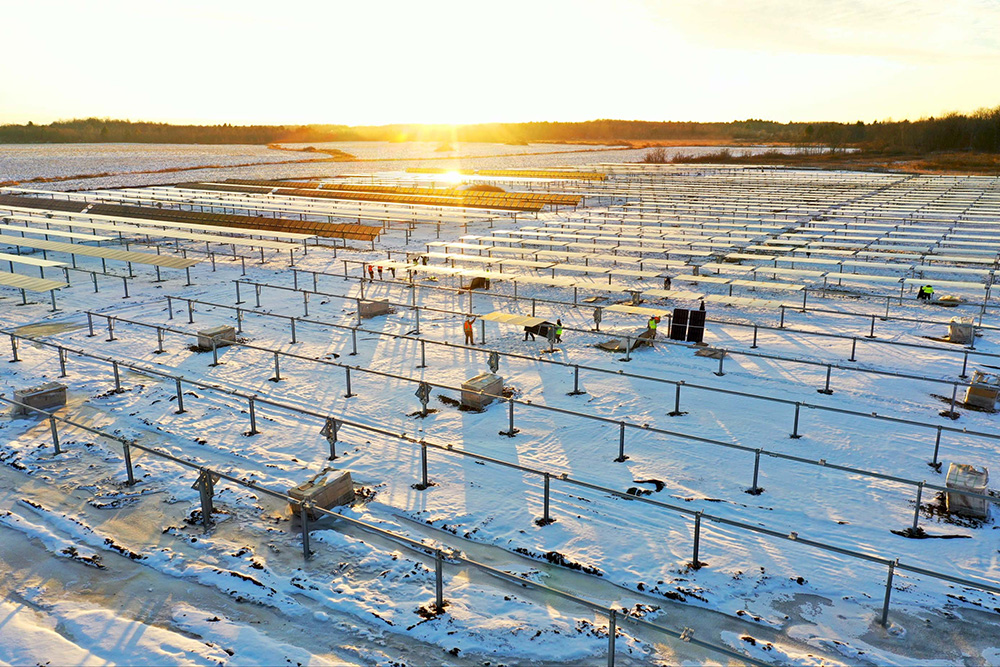
The foundation of a tracker, as with any structural foundation, must be designed to resist reasonably likely loads that may be applied to it. The most common loads acting on a tracker are its self-weight; snow accumulation on the modules; and wind acting both vertically and horizontally on the tracker. In colder climates, foundations may need to be designed to address frost heave as well. All foundation types are susceptible to frost heave, but we will limit this discussion to deep foundations such as driven piles, since those are the most common foundation type for trackers.
What is frost heave?
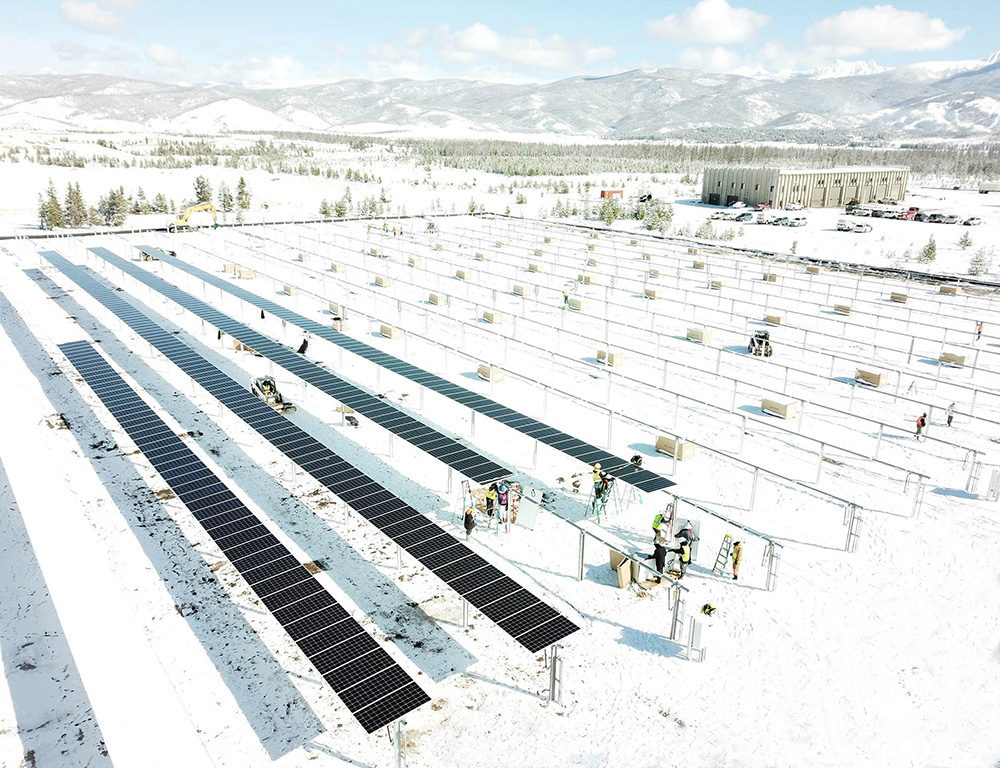
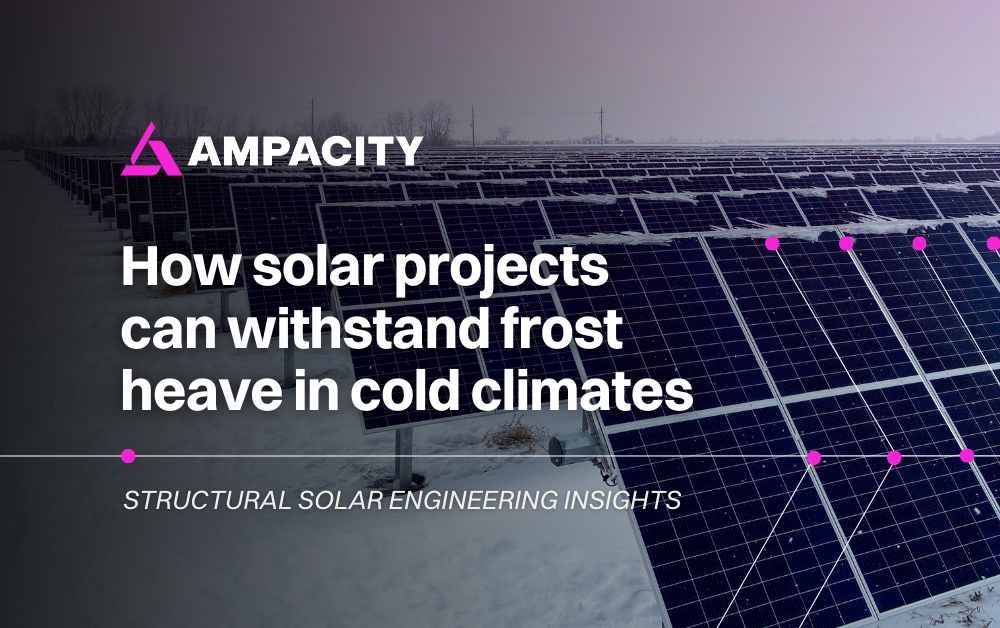
Frost heave is a phenomenon where frozen soil adheres to a foundation element, like a pile, and imparts upward pressure on the foundation when the soil expands. If the foundation element is unable to resist the upward pressure, it displaces with the soil. When the soil thaws, it may return to its original position, but it also may not. If this occurs over several cycles, the foundation could heave out of the ground.
There are typically three ingredients needed for frost heave to occur: freezing temperatures, frost-susceptible soil, and shallow groundwater. The first ingredient is obvious—without it there would be no frozen soil. Frost-susceptible soil contains a high silt content. Silt is a fine-grained soil, somewhere between sand and clay. The void spaces between the grains of silt are large enough to contain water, but small enough that water can migrate upwards in the soil through capillary action, much like how a wick draws oil up in a lantern. When the water in the soil freezes, it forms ice lenses and expands. Water in the soil freezes from the ground surface, downwards when freezing temperatures persist. In order for more water to freeze, there must be a supply of water from below; surface water cannot penetrate the already-frozen soil. Coarse-grained soil, like sand and gravel, also contains void spaces that can contain water. However, the voids are too large to allow for capillary action to draw additional water up from below. The particles of clay soil are extremely small with small void spaces between them. This makes it very difficult for water to migrate through the clay. (Good thing, or clay pots would never work.) It should be noted that even sites that have all three ingredients necessary for frost heave still may not experience the phenomenon. Similarly, a site that lacks one of the ingredients is not necessarily immune to frost heave. There are only degrees of susceptibility.
What do building codes say about frost heave?
Remarkably little. Most building codes suggest, or require, that foundations must terminate below the frost line. But this requirement is intended for shallow foundations like strip footings. A driven pile will always extend below the frost line. The problem is that building codes were developed primarily for buildings. For these kinds of structures, there is no issue with constructing the foundation below the frost line. So, the discussion of frost heave can end there. Because of this, or maybe despite it, building codes give no guidance on an appropriate or acceptable frost heave force to be applied to driven piles. For tracker foundations, we need to develop the loads we deem reasonable or likely. The few studies that have been conducted related to adfreeze (the bond that forms between frozen soil and steel piles) suggest a bond that can vary from as little as 5 psi to as much as 45 psi. These might sound like small values, but they are equivalent to 700 psf to 6500 psf. To put this in perspective, typical values of bond between non-frozen soil and a driven pile (skin friction) vary from about 25 psf to 700 psf.
How large is the frost heave force?
 Calculating the uplift force on a pile due to frost heave is fairly simple. It’s just the adfreeze stress multiplied by the surface area of the pile in contact with frozen soil. Unfortunately, this simple equation has many unknowns. Should we consider an adfreeze stress of 5 psi, 45 psi, or something in between? What is a reasonable frost depth? Most local building codes will specify this depth, but it is usually deeper than the actual depth of frozen soil.
For a building foundation, this exact depth is not significant. But for a small pile, this has a large impact. Also, the entire frost depth does not freeze all at once. It could take weeks of freezing temperatures for the frost to penetrate 3 feet or more. How does that affect the magnitude of frost heave force? We can calculate a lower bound and upper bound for the frost heave force by looking at the extremes. If we assume 5 psi adfreeze stress, a 12-inch frost depth, and a W6x9 pile, we would develop a frost heave force of about 1,700 lbs as a lower bound. On the other extreme, if we assume a 45 psi adfreeze stress, a 48-inch frost depth and a W6x15 pile, we would develop a frost heave force of over 77,000 lbs as an upper bound. A more typical value of adfreeze stress suggested in many geotechnical reports is 10.4 psi to 14.5 psi (from a Canadian design code.) If we assume a 36-inch frost depth and a W6x9 pile, we would get a typical frost heave force of between 10,500 lbs to 14,600 lbs.
How can you address frost heave in foundation design?
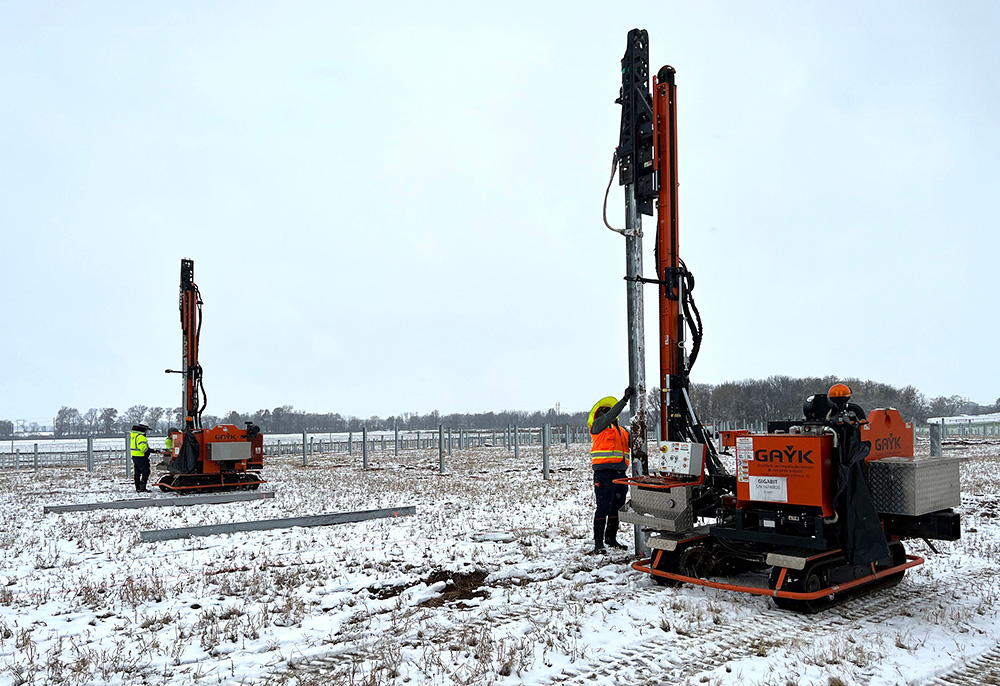
If the soil adheres to the pile and the soil heaves up, the pile will heave with it. One solution to prevent this heave is to anchor the pile into the ground below the frost line to develop an uplift capacity that exceeds the uplift force from frost heave. If successfully anchored, the bond between the frozen soil and the pile will be broken and the soil will heave independently from the pile. For a driven pile, the uplift capacity is derived through the bond that develops between the soil and the pile (skin friction), and the embedment of the pile below the frost line. This solution typically involves embedment depths deeper than 15 or 20 feet. Other deep foundation elements can also help develop large uplift capacity with less embedment, such as screw piles and helical piles.
What are alternatives to resisting frost heave?
 As mentioned above, “if the soil adheres to the pile…” Well, if we prevent the soil from adhering to the pile, it doesn’t matter if the soil heaves; it won’t be able to take pile with it.
Our preferred method of breaking the bond between the soil and the pile is to install a bond breaker, such as the Yellow Jacket sleeve, around the pile. This solution involves pre-drilling an oversized hole (8” to 12” in diameter) through the frost depth, placing the pile in the hole, wrapping the sleeve around the pile and sliding it down the hole, backfilling the hole with native soil or imported sand and then driving the pile to its final embedment.
Another method of breaking the bond between the soil and the pile is to pre-drill an oversized hole (12” in diameter) through the frost depth at each pile location and backfill with clean, coarse sand or washed gravel before driving the pile. The backfill must be “clean,” which means its gradation must have less than 6% fines passing the #200 sieve. This gradation is non-frost-susceptible. Even though the sand breaks the soil/pile bond vertically, it still provides support for the pile laterally, so there is no penalty in the foundation’s performance.
Of course, these alternatives come with a cost, both in material and time for installation. So, another alternative is to recognize that there is some risk associated with foundations in frost-susceptible regions and accept it. Instead of spending money on more expensive foundations, use that money for maintenance and repair foundations if and when it’s needed.
Frost heave can be a challenging phenomenon to predict, quantify, and pay for. If it presents itself, the consequences can be expensive. Designing foundations to address frost heave can also be expensive.
Since building codes are silent on how to design deep foundations with respect to frost heave, the client or owner must provide the basis for its design. That is, they must provide guidance on what is considered acceptable. It is not possible to simply provide a design that “meets the code.”
Ampacity has extensive experience with designing and installing driven piles in areas where frost heave is a concern. We work closely with clients and owners to develop a solution that is both technically and financially viable.
Contact Ampacity’s structural team today for help designing solar projects in cold climates.
 Mario Colecchia is a senior structural engineer with Ampacity, responsible for the foundation designs of the Array Technologies and Nextpower tracker structures, as well as the design of ancillary structures related to solar projects. Colecchia has been with Ampacity since 2020 and has been working in the solar industry since 2011. He is a licensed Professional Engineer (PE) and Structural Engineer (SE) registered in 45 states where Ampacity designs and builds solar projects.
With thousands of projects designed around the country, Colecchia has experience with foundations installed in all varieties of soil and challenging conditions. He is continually looking for optimizations to make projects more economical and constructible.
Prior to transitioning to the solar industry, Colecchia spent his engineering career designing bridges and other transportation-related structures. He graduated Magna Cum Laude from Princeton University with a Bachelor of Science in Engineering and from The University of Texas at Austin with a Master of Science. Colecchia is a former Adjunct Professor of Structures at Essex Community College where he taught an introductory class in steel, concrete, and timber design emphasizing LRFD to sophomore-level college students. His teaching experience began at Princeton University where, as a teaching assistant, he led a class that introduced engineering concepts to liberal arts students and reviewed papers for publication.