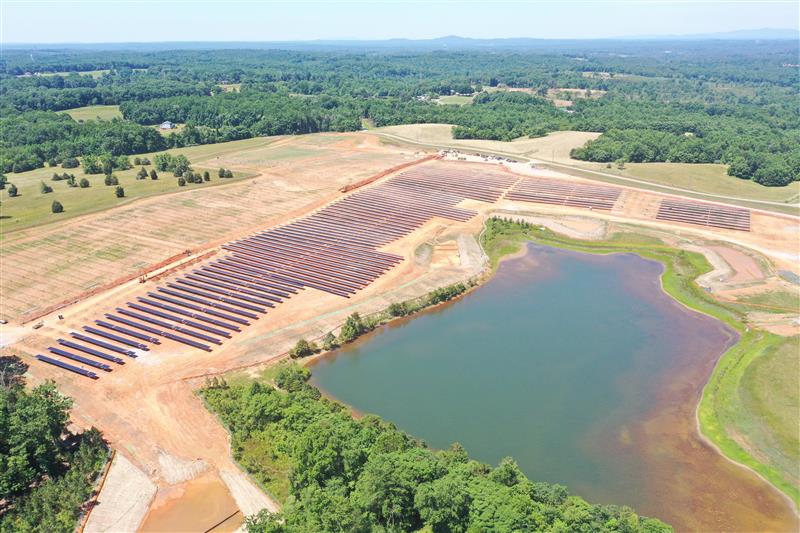
 Solar projects are long-term energy investments, but they won’t last forever. By partnering with a highly skilled design team and selecting premium structural supports for your project, you can ensure your project operates safely as long as possible.
Measuring the expected design lifespan of solar projects is possible by assessing a few key elements. “Factor of safety” is defined as the ratio of a structure’s capacity to the demand placed on that structure. It can be thought of as excess capacity above the required design loads. Its purpose is to provide a measure of safety against failure due to underestimated loads, overestimated capacity, or a combination of both. The larger the factor of safety, the greater a structure’s reserve capacity. The factor of safety should always be greater than 1.0, otherwise, the capacity of a structure would be less than the demand placed on that structure.
The American Institute of Steel Construction (AISC) has developed design specifications that are generally accepted for the design of steel structures. These specifications provide guidance to determine the capacity of steel structures and components, and the minimum factor of safety for steel structures and components. For beam-column elements loaded primarily in bending and compression, the minimum factor of safety is 1.67. Driven steel piles, like those used as tracker foundations, are classified as beam-column elements and are governed by the AISC design specifications and factor of safety.
“Design life” is the length of time for which a structure or element is expected to safely meet all design requirements. Therefore, a structure must maintain at least the minimum factor of safety through to the end of its design life.
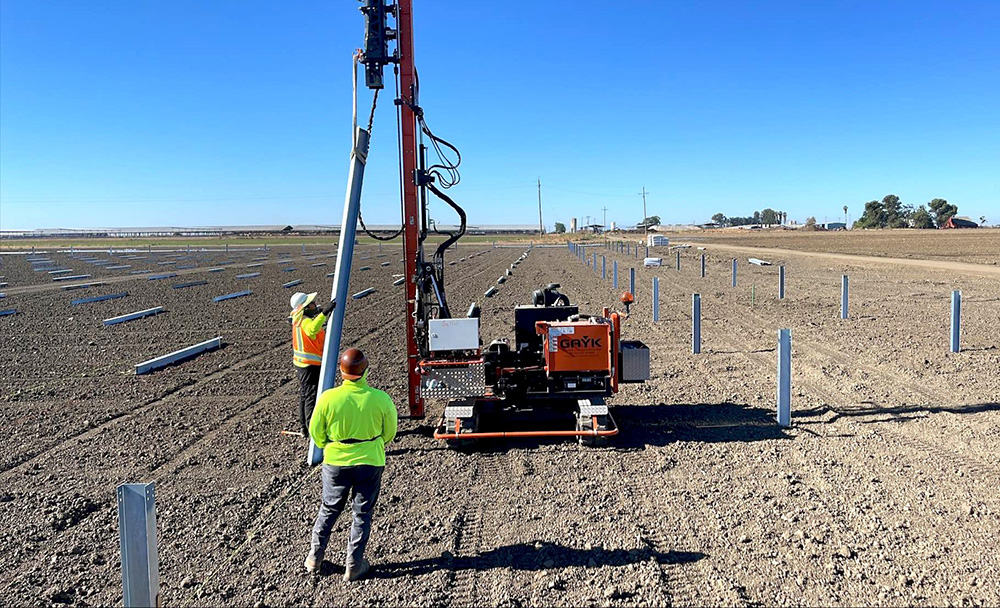 A driven steel pile embedded in the ground will suffer deterioration from corrosion. Hot dip galvanization will delay the corrosion of the steel; however, some loss of steel section is inevitable. The longer the pile remains in service, the more the steel corrodes, the more section loss it will suffer, and the greater its loss of capacity. Since the demand on the structure does not change with time, a reduction in capacity results in a reduction in the factor of safety. Unlike above-ground structures that can be rehabilitated to preserve their structural integrity and maintain their factor of safety, driven piles cannot be modified after installation; at least, not economically. Therefore, the pile must be designed with a factor of safety that exceeds the code-specified minimum when first placed into service so that it will still have sufficient capacity at the end of its design life.
Since its inception, Ampacity has been designing and installing foundations for trackers that safely and economically exceed structural requirements throughout a facility’s design life, protecting the owner’s assets and investment.
Contact Ampacity’s structural team today to help make the best foundation plan for your solar project.
 Mario Colecchia is a senior structural engineer with Ampacity, responsible for the foundation designs of the Array Technologies and Nextpower tracker structures, as well as the design of ancillary structures related to solar projects. Colecchia has been with Ampacity since 2020 and has been working in the solar industry since 2011. He is a licensed Professional Engineer (PE) and Structural Engineer (SE) registered in 45 states where Ampacity designs and builds solar projects.
With thousands of projects designed around the country, Colecchia has experience with foundations installed in all varieties of soil and challenging conditions. He is continually looking for optimizations to make projects more economical and constructible.
Prior to transitioning to the solar industry, Colecchia spent his engineering career designing bridges and other transportation-related structures. He graduated Magna Cum Laude from Princeton University with a Bachelor of Science in Engineering and from The University of Texas at Austin with a Master of Science. Colecchia is a former Adjunct Professor of Structures at Essex Community College where he taught an introductory class in steel, concrete, and timber design emphasizing LRFD to sophomore-level college students. His teaching experience began at Princeton University where, as a teaching assistant, he led a class that introduced engineering concepts to liberal arts students and reviewed papers for publication.