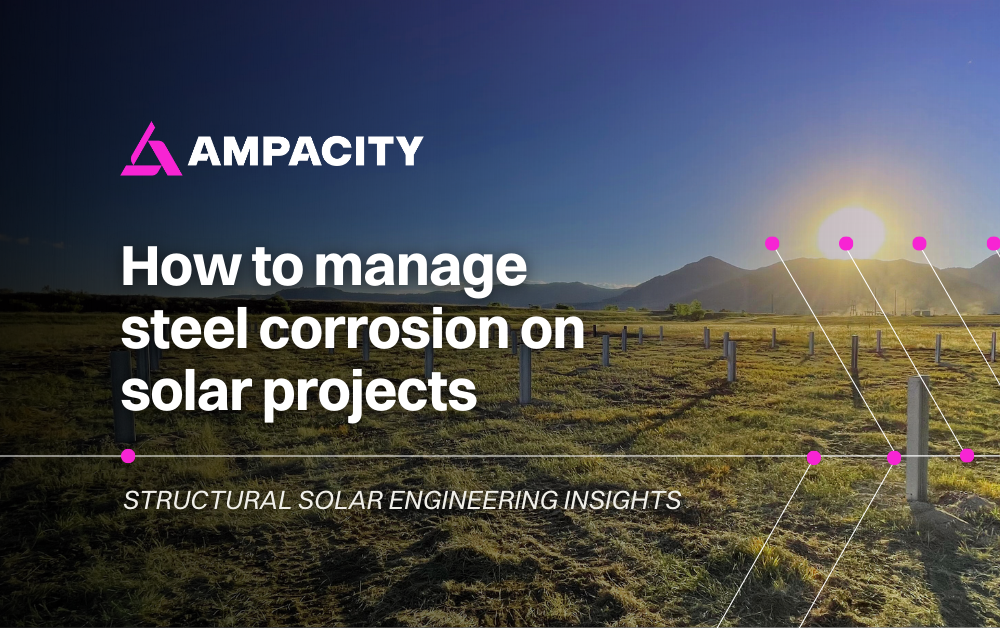
It’s no surprise that steel corrodes. It’s also no major revelation that steel corrodes at different rates in different environments. Steel in the arid desert will last much longer than steel exposed to ocean spray. Similarly, steel that is embedded in the ground also corrodes, and corrodes at different rates depending on the composition of the soil. Corrosion is a common concern for solar project developers, but there are plenty of design precautions to take to mitigate those worries.
What is steel corrosion?
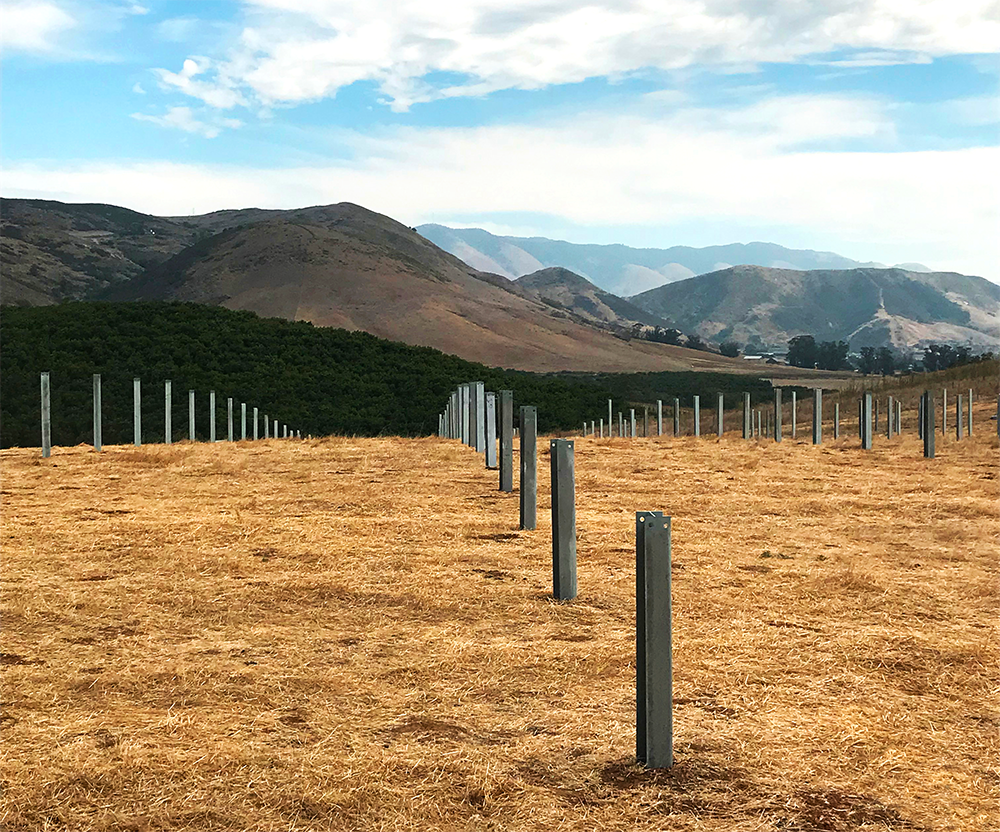
Steel corrosion is an electro-chemical process where oxygen combines with the iron in the steel to form iron-oxide (rust). Environmental conditions in the soil can either promote or deter corrosion. For example, soils with higher moisture content will accelerate corrosion rates whereas dry soils tend to corrode steel at a slower rate. Soils that are highly acidic or highly alkaline tend to corrode steel faster than soils that have a more neutral pH. Soils with a low electrical resistivity promote the transfer of electrons and facilitate faster corrosion rates whereas soils with higher electrical resistivity interfere with the transfer of electrons and slow the corrosion process.
Relative descriptions like “more corrosive” and “less corrosive” are fine. But if you are interested in designing a steel structure that is embedded in the ground, then you need to know just how much corrosion to expect. Of the soil properties mentioned above, electrical resistivity provides a way to quantify corrosion rates.
A geotechnical investigation should include either field measurements of the soil electrical resistivity or laboratory tests of the soil electrical resistivity; field measurements are preferred. With site-specific electrical resistivity, we can estimate corrosion rates. Combined with the project-specific design life, we can estimate the total amount of corrosion on an embedded steel pile and design it to have sufficient structural capacity throughout its design life. Ampacity follows this approach on all foundation designs it produces.
Reducing corrosion on solar tracker systems
There are ways to reduce the amount of corrosion that an embedded steel pile may experience. The most common method is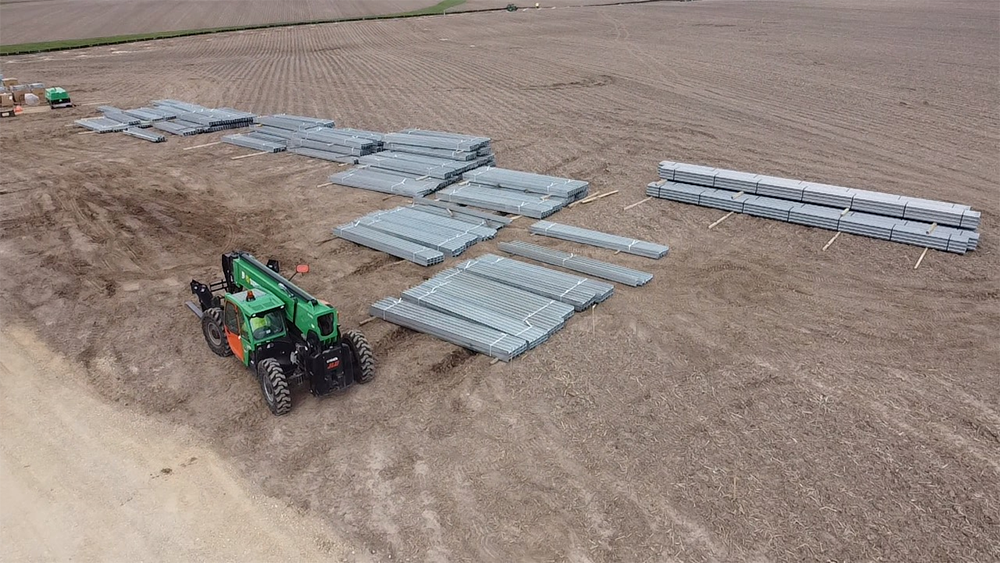 to galvanize the steel. Galvanization results in a thin layer of zinc bonding to the surface of the steel. Zinc will combine with oxygen more readily than iron. As a result, the zinc sacrifices itself to corrosion, thereby protecting the steel from corrosion, much the same way the anode rod in a water heater protects the steel tank from corroding. Unfortunately, the protection offered by the zinc coating is finite. Eventually the zinc is consumed, and the steel begins to corrode. There are limits to the thickness of the zinc coating, with thicker coatings becoming brittle and flaking off.
It is possible to incorporate external cathodic protection where zinc anodes are buried in the ground and electrically bonded to the piles. Like with galvanization, the zinc anodes are consumed and need to be replaced periodically. Each tracker needs to have one or more anodes bonded to it to be effective. There are also epoxy coatings that can be applied to the surface of the piles. These coatings prevent the soil from making direct contact with the steel, thus preventing corrosion. As long as the epoxy is not damaged during pile-driving operations, these coatings can be very effective since they are not consumed over time. These coatings can, however, be cost-prohibitive on a massive site with a large number of piles.
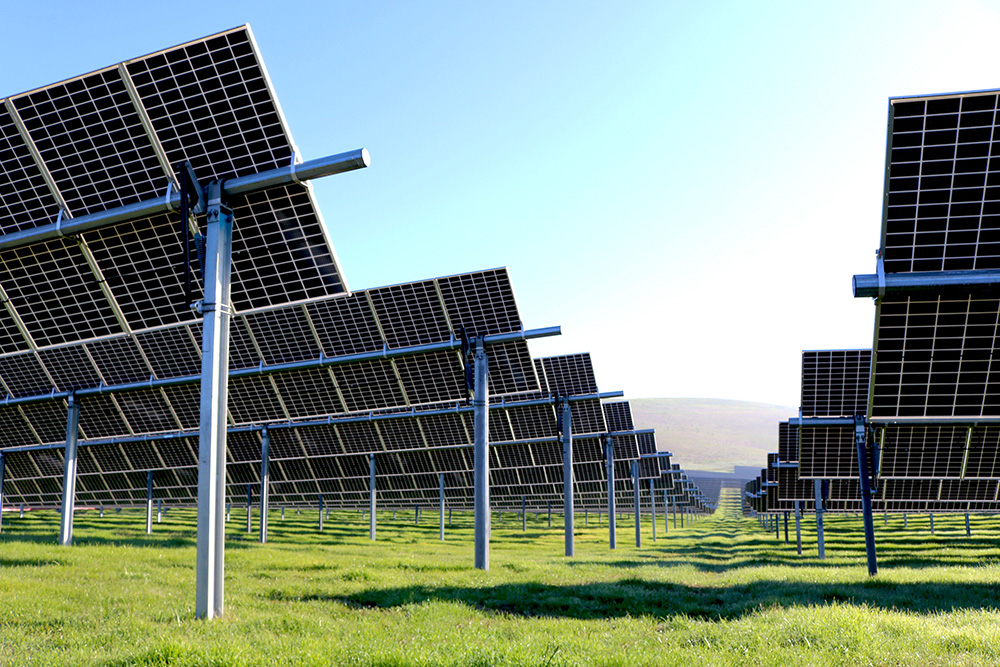
It is often more cost-effective to upsize the pile and provide an allowance for the loss of steel section than to apply expensive coatings. If the soil conditions are appropriate, bare steel without galvanization can also be considered. One size does not fit all, and every project is different. Alternative methods of protection still have a place and can be considered.
Ampacity has developed tools for modeling the corrosion of steel piles and its effect on pile capacity; and we can design foundations in the most corrosively challenging soils. We are also experienced in the use of protective coatings. As a result, facility owners can be confident that the asset we provide for them will stand the test of time.
Contact Ampacity’s structural team today to help design the most reliable large-scale solar project.
 Mario Colecchia is a senior structural engineer with Ampacity, responsible for the foundation designs of the Array Technologies and Nextpower tracker structures, as well as the design of ancillary structures related to solar projects. Colecchia has been with Ampacity since 2020 and has been working in the solar industry since 2011. He is a licensed Professional Engineer (PE) and Structural Engineer (SE) registered in 45 states where Ampacity designs and builds solar projects.
With thousands of projects designed around the country, Colecchia has experience with foundations installed in all varieties of soil and challenging conditions. He is continually looking for optimizations to make projects more economical and constructible.
Prior to transitioning to the solar industry, Colecchia spent his engineering career designing bridges and other transportation-related structures. He graduated Magna Cum Laude from Princeton University with a Bachelor of Science in Engineering and from The University of Texas at Austin with a Master of Science. Colecchia is a former Adjunct Professor of Structures at Essex Community College where he taught an introductory class in steel, concrete, and timber design emphasizing LRFD to sophomore-level college students. His teaching experience began at Princeton University where, as a teaching assistant, he led a class that introduced engineering concepts to liberal arts students and reviewed papers for publication.