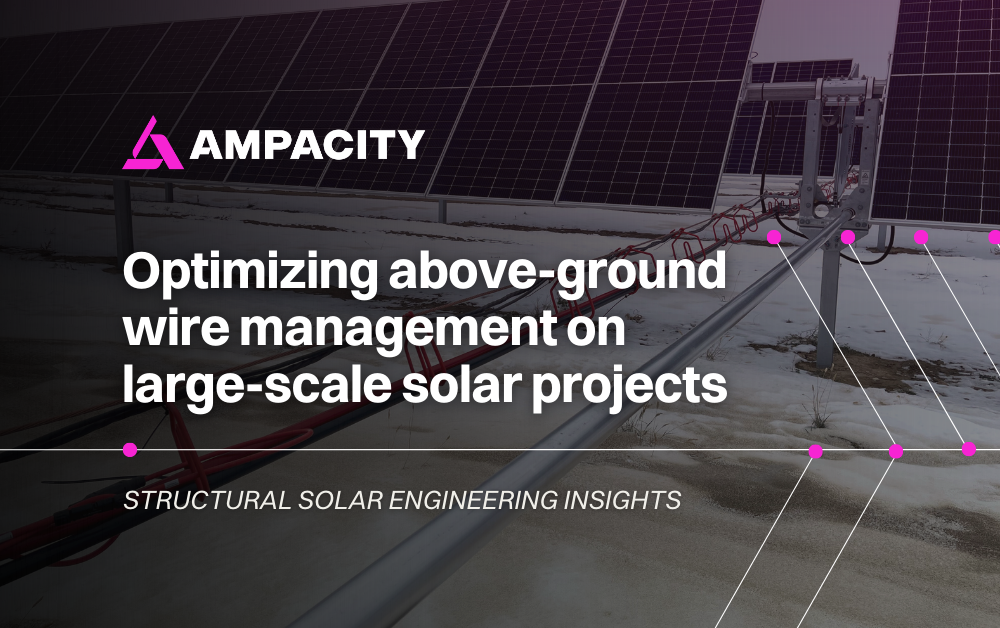
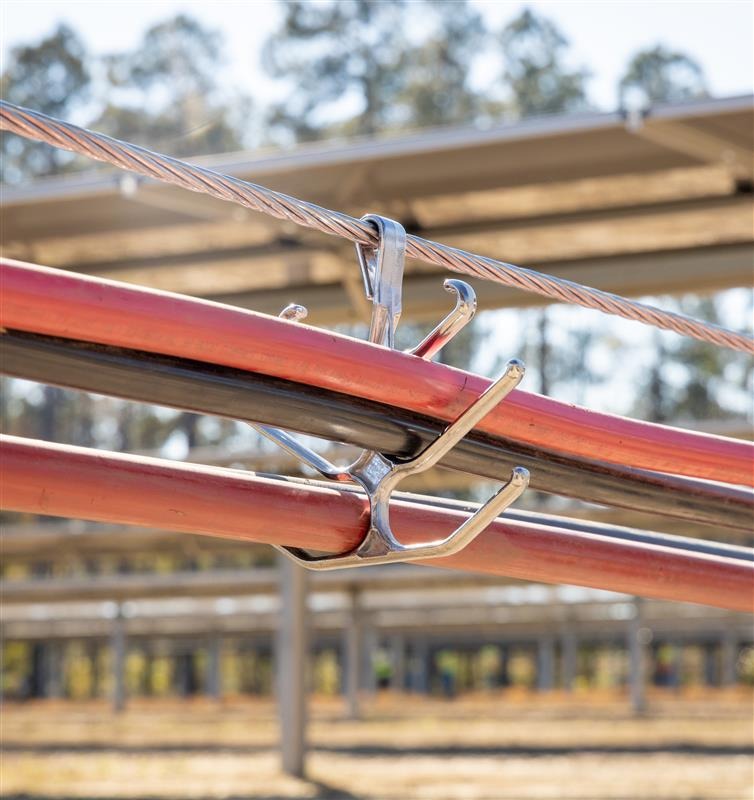
 Choosing an above-ground wire management system (WMS) for large solar projects helps installers avoid trenching and makes materials more accessible for O&M over the array’s lifespan. Above-ground wire management systems are composed of a steel messenger wire, hangers, brackets, and other fittings supported by piles. The tracker foundation piles are often used to support the WMS, although the WMS can also be supported on its own dedicated piles.
If supported by the tracker foundation piles, the WMS will introduce some loads to those piles in addition to the tracker loads. Obviously, dead load (the weight of wires and the WMS itself) will need to be carried by the foundation piles. In colder climates, ice can form on the wires. The weight of this ice must also be carried by the foundation piles. In most cases, this additional weight is small relative to the loads from the tracker. However, if the soil is loose or weak, this additional load could result in slightly deeper pile embedment.
The WMS can run either north-south (along a tracker row) or east-west (between tracker rows). For north-south runs, the WMS can be mounted to either the tracker pile or the tracker torque tube. For east-west runs, the WMS usually runs adjacent to the gear pile or motor pile where a gap between the modules naturally occurs. However, east-west run can also be located at the ends of tracker rows.
Load limits
Determining the dead load of the WMS is straightforward—just add up the weight of all the wires being carried. Wire weight is usually given in pounds per foot. Multiply this weight by the spacing between pile supports and you have the dead load acting on a bracket. Determining ice load can be a bit more complicated, but if you want a ballpark estimate, you can assume it will be about the same as the dead load.
Dead-end piles
The WMS is a cable structure, meaning it’s able to carry a significant amount of load over large spans very efficiently simply by placing a slender cable (the messenger wire) in tension. When the messenger wire runs over a support, the tension in the wire on one side of the support is balanced by the tension in the wire on the other side. The support needs to carry only the vertical weight of the WMS, but eventually, the WMS run must come to an end.
The last support at the end of a WMS run does not have balanced tension on both sides. Therefore, the last support at the end of a WMS run must carry a substantial horizontal load in addition to vertical load. This last support in the WMS run is called the “dead-end support,” or “dead-end pile.” The tension in a fully loaded messenger wire can be on the order of 1500 to 2000 pounds. This is comparable to the load on a tracker pile. As a result, it is fair to assume that the dead-end piles of a WMS will be the same size and have the same embedment depth as a tracker foundation pile. Remember that the dead-end pile must be oriented such that the messenger wire is parallel to the web of the pile; that is, the pile must be loaded in its strong direction.
WMS messenger wire installation sag
As mentioned above, the WMS is a cable structure with a messenger wire under tension. Cable structures have been around for centuries, but predicting the behavior of a cable structure is not so simple.
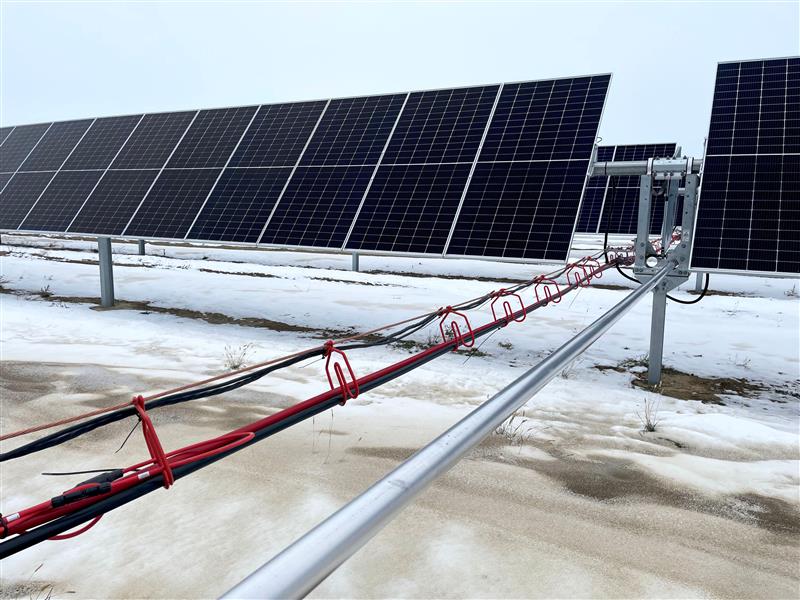
The tension in the messenger wire of a WMS is sensitive to the loads on the wire and to the sag in the messenger wire. The sag of the messenger wire is very sensitive to the length of the wire, the distance between supports, elongation or contraction of the wire due to temperature changes, and movement of the supports.
But you do not need to worry about the impacts of all these variables on the WMS messenger wire—we here at Ampacity perform all the analysis needed. The most important detail when installing a WMS is providing the right amount of sag in the messenger wire given the span length between supports and the temperature of the messenger wire at the time of installation. When our recommendations are followed, the messenger wire and dead-end pile will satisfy all structural needs of the wire management system.
Contact Ampacity today to plan your project and its above-ground wire management system.
 Mario Colecchia is a senior structural engineer with Ampacity, responsible for the foundation designs of the Array Technologies and Nextpower tracker structures, as well as the design of ancillary structures related to solar projects. Colecchia has been with Ampacity since 2020 and has been working in the solar industry since 2011. He is a licensed Professional Engineer (PE) and Structural Engineer (SE) registered in 45 states where Ampacity designs and builds solar projects.
With thousands of projects designed around the country, Colecchia has experience with foundations installed in all varieties of soil and challenging conditions. He is continually looking for optimizations to make projects more economical and constructible.
Prior to transitioning to the solar industry, Colecchia spent his engineering career designing bridges and other transportation-related structures. He graduated Magna Cum Laude from Princeton University with a Bachelor of Science in Engineering and from The University of Texas at Austin with a Master of Science. Colecchia is a former Adjunct Professor of Structures at Essex Community College where he taught an introductory class in steel, concrete, and timber design emphasizing LRFD to sophomore-level college students. His teaching experience began at Princeton University where, as a teaching assistant, he led a class that introduced engineering concepts to liberal arts students and reviewed papers for publication.